
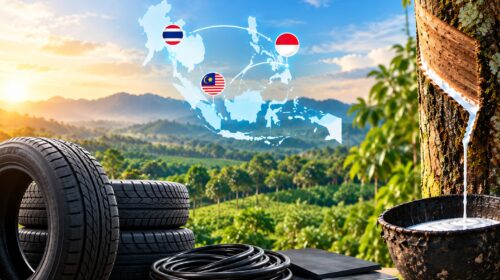
Southeast Asia’s Rubber Industry: Could Regional Integration Reshape the Global Supply Chain?
From raw material sourcing to high-value manufacturing, closer cooperation between Thailand, Malaysia and Indonesia could create new opportunities—and new challenges—for global rubber businesses.
A recent initiative in Malaysia highlights this potential shift. The Malaysian government is conducting a six-month study on stronger rubber industry cooperation with Thailand and Indonesia, focusing on price volatility, labor shortages, technology gaps and differences in product quality standards. The findings are expected in early Q2 2027.
Although this is still a study rather than a confirmed regional integration plan, it gives global rubber businesses a reason to reassess their sourcing, manufacturing and investment strategies in Southeast Asia.
1. Three Countries, Complementary Strengths
Thailand and Indonesia are major natural rubber producers, while Malaysia has an established downstream rubber products industry, including medical and latex products, industrial components and other manufactured goods.
These complementary capabilities could provide a foundation for stronger regional supply chains. Industrial platforms such as Malaysia’s Kedah Rubber City, Indonesia’s Sei Mangkei Rubber City and Thailand’s Songkhla Rubber City are relevant to efforts to develop rubber processing and manufacturing capacity.
For international companies, the strategic question is increasingly broader than where to buy natural rubber. It is also where to process materials, manufacture components and serve customers competitively.
However, closer cooperation will not automatically eliminate differences in infrastructure, regulations, logistics costs or technical capabilities. Businesses must evaluate each country’s advantages individually rather than treating Southeast Asia as a single, uniform market.
2. Three Trends Global Rubber Companies Should Watch
Raw material sourcing: Reliability beyond price
Natural rubber prices fluctuate with weather conditions, production cycles, global demand and supply disruptions. These changes affect procurement costs, inventory planning and manufacturers’ margins.
Greater regional coordination could eventually improve supply-chain visibility and create additional sourcing options. However, it should not be assumed that cooperation will immediately stabilize prices or reduce costs.
Procurement teams should compare suppliers based on product grades, quality consistency, delivery reliability, logistics, traceability and supply risks—not price alone. Diversifying qualified suppliers across several markets may also help reduce dependence on a single source.
Quality standards and technology: A potential competitive advantage
Differences in quality standards and technology are among the issues identified in Malaysia’s study.
For tire manufacturers, automotive suppliers and industrial rubber producers, consistent material properties and reliable quality control are essential. Greater alignment in testing methods, technical requirements and supplier qualification could eventually make cross-border sourcing and manufacturing easier.
For now, harmonized standards remain a possibility rather than an established outcome. Businesses should monitor whether the initiative leads to concrete changes in certification, testing, technical collaboration or supplier qualification.
The same developments could create opportunities for equipment manufacturers and technology providers specializing in rubber processing, automation and quality testing.
Downstream manufacturing: Capturing more value
Southeast Asia’s opportunity extends beyond natural rubber production to higher-value products, including precision-engineered components, advanced rubber materials and automotive applications.
Global companies should consider whether different stages of their value chains could be located in different countries. Raw materials might be sourced in one market, processed in another, and incorporated into finished products close to major customers.
Such arrangements could benefit rubber compounders, tire manufacturers, automotive component suppliers and industrial rubber producers. But investment decisions must account for labor and energy costs, infrastructure, customer access, technical talent, environmental requirements and regulatory conditions.
3. What the Developments Mean for Global Businesses
- Tire manufacturers: Review supplier concentration, alternative sourcing options and the consistency of raw material quality.
- Industrial rubber producers: Assess local manufacturing and partnership opportunities that could improve customer access and delivery efficiency.
- Traders and procurement companies: Evaluate suppliers using total landed cost, quality, reliability and traceability rather than headline prices alone.
- Equipment and technology providers: Monitor potential demand for automation, testing systems and more efficient processing technologies.
- Investors: Distinguish between policy announcements, planned projects, committed investment and operational capacity before making investment decisions.
The commercial implications will differ by business model. A sourcing opportunity for a tire producer may not represent the best location for a precision component manufacturer. Company-specific market validation remains essential.
4. Three Practical Steps to Take Now
First, map the regional value chain. Identify major suppliers, processors, industrial parks, component manufacturers and end users across Thailand, Indonesia and Malaysia.
Second, validate real market demand. Interviews with buyers, distributors and local manufacturers can help establish actual purchasing requirements, competitive pricing, production feasibility and potential partners.
Third, track implementation, not just announcements. Changes in technical standards, infrastructure, supplier partnerships and industrial investment will provide stronger evidence of progress than policy statements alone.
Conclusion
Closer cooperation between Thailand, Malaysia and Indonesia could create new opportunities across Southeast Asia’s rubber supply chain, from raw material sourcing to higher-value manufacturing. But the scale and timing of any impact remain uncertain.
For global rubber businesses, the priority is not to assume that regional integration will transform the market overnight. It is to identify where potential changes could improve sourcing resilience, manufacturing competitiveness or access to customers—and verify those advantages before committing capital.
A country-by-country, supplier-by-supplier assessment will be essential to turning regional industrial developments into sound business decisions.